
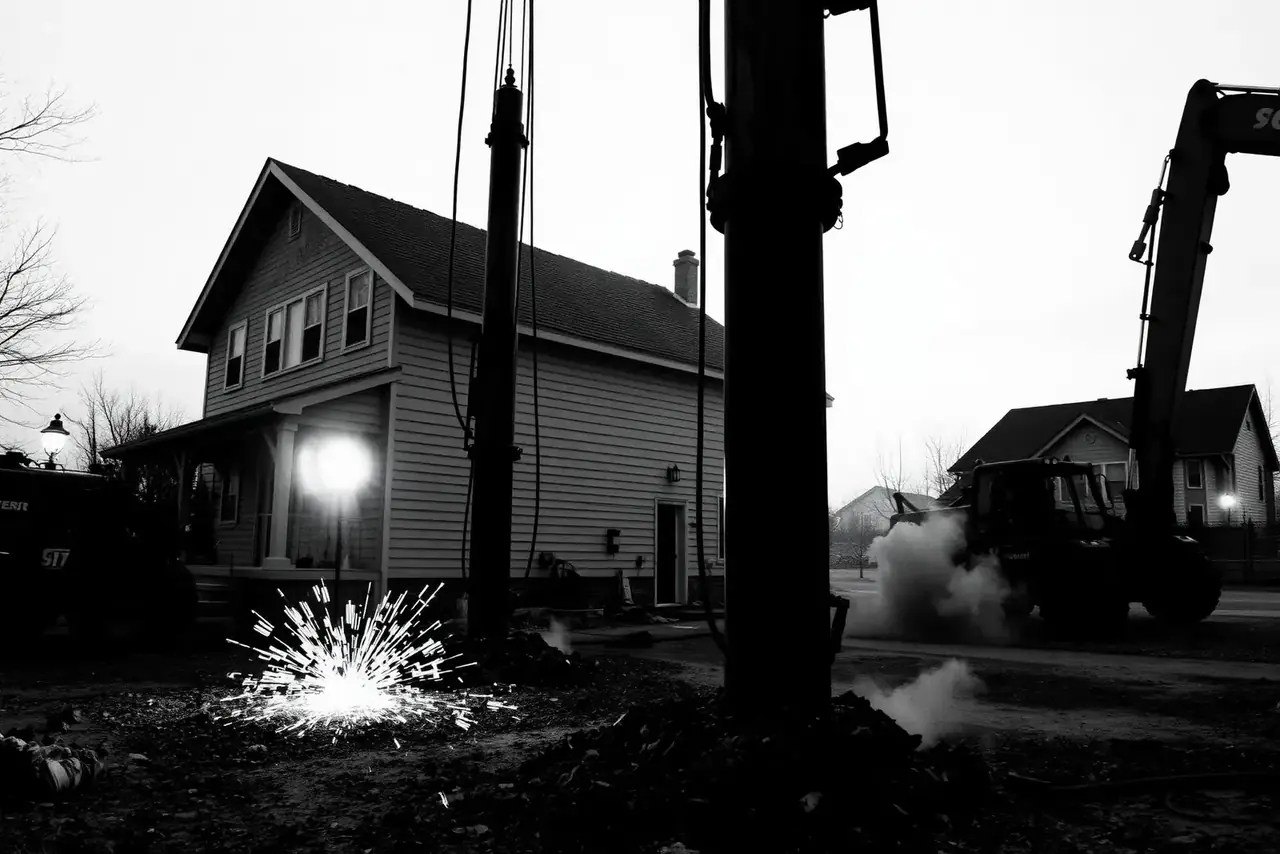
Slab Foundation Repair
In The RGV.
Action House Leveling delivers permanent slab foundation repair in the Rio Grande Valley. 4,500–5,000 PSI reinforced concrete piers — built around a Grade 60 steel rebar cage — anchor your slab past expansive clay to load-bearing strata across Mercedes, McAllen, Harlingen, and Brownsville.
Why slab foundations fail in the Rio Grande Valley.
Concrete slabs across the RGV sit on highly expansive clay. After heavy rains the clay swells and pushes the slab upward; in long dry stretches it shrinks and the slab drops. That cycle — repeated season after season from Brownsville to Rio Grande City — cracks the slab, racks the framing above it, and pulls the home out of level. Surface patches don't stop the movement. Only reinforced concrete pier slab foundation repair does — and unlike steel piers (bare, galvanized, or epoxy-coated all rely on a finite coating), our 4,500–5,000 PSI concrete piers (with a Grade 60 steel rebar cage inside) won't corrode in the Valley's wet, chloride-rich soil.
Lifetime Warranty
Every reinforced concrete pier we install under your slab carries a transferable lifetime warranty.
4,500–5,000 PSI Concrete Piers
Reinforced with a Grade 60 (60,000 PSI) steel rebar cage and driven 20–30 ft past expansive clay. Concrete doesn't rely on a sacrificial coating like bare, galvanized, or epoxy-coated steel piers do in RGV soil.
Laser-Verified Lift
Hydraulic recovery monitored to 1/16-inch precision. Slab returned to elevation.
Does your slab need repair?
Catching slab foundation problems early saves thousands. If you notice any of these signs in your RGV home, schedule a free slab foundation repair inspection.
- Stair-step cracks in exterior brick or block
- Cracks in the concrete slab or interior tile
- Doors and windows that stick or won't latch
- Gaps between baseboards, walls, and ceilings
- Sloping or uneven concrete floors
- Separation around exterior trim and chimneys
Our slab repair
method.
Elevation Survey
Laser elevation readings across the slab to map exactly where it has dropped.
Pier Layout
Engineered pier plan based on load points and the depth of stable soil under your home.
Concrete Pier Installation
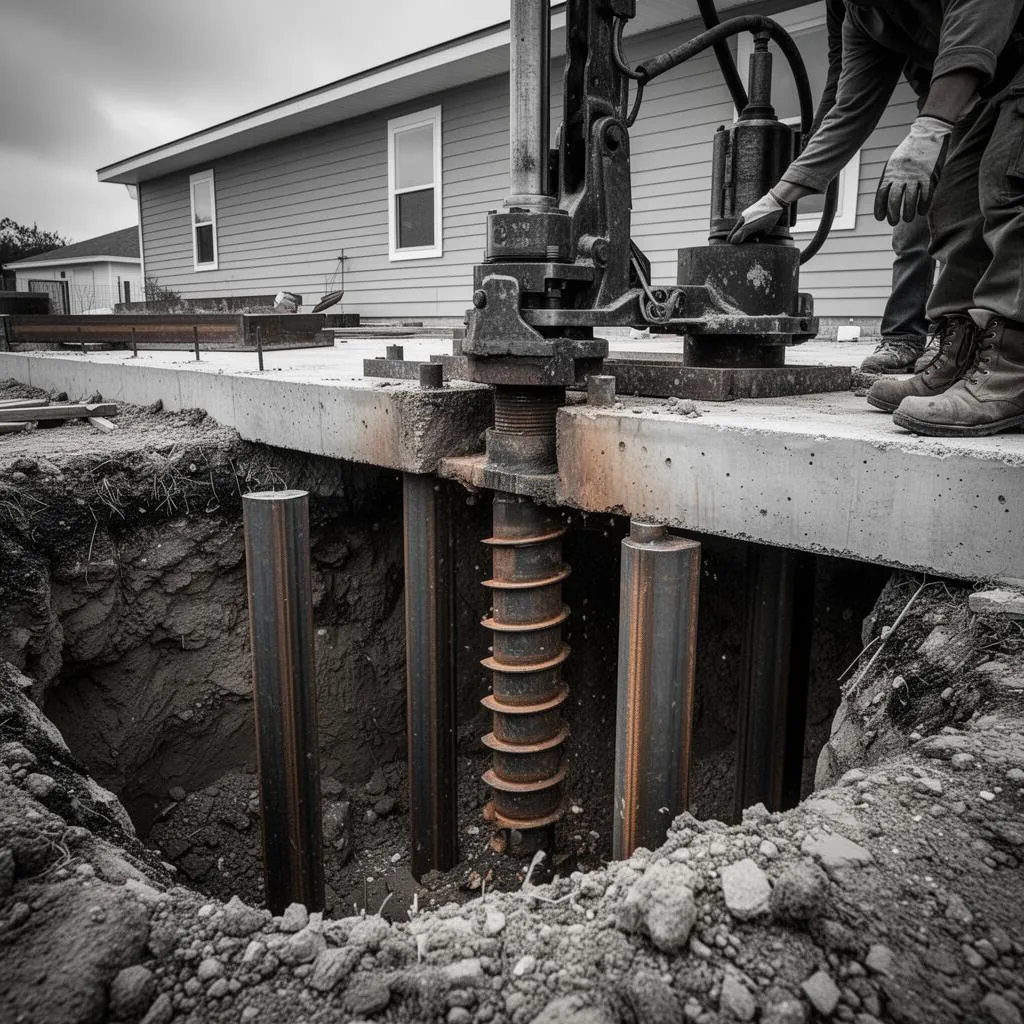
4,500–5,000 PSI reinforced concrete piers (Grade 60 rebar cage inside) hydraulically driven 20–30 ft past expansive clay to refusal.
Lift & Lock
Slab synchronously lifted back to elevation and permanently locked onto the new piers.
Methods we use for slab repair.
We don't believe in one-size-fits-all. Every slab job is engineered around the soil, the load, and how far the home has moved. Here are the proven techniques our crews use across the Rio Grande Valley.
Reinforced Concrete Piers
4,500–5,000 PSI reinforced concrete driven 18–35 ft past expansive clay to load-bearing strata. End-bearing, not friction — they don't move when the soil does.
Concrete Pressed Pilings
Stacked concrete cylinders pressed into the soil for lighter loads or specific engineering scenarios. Used selectively where conditions favor them.
Synchronized Hydraulic Jacking
Multiple hydraulic jacks lift the slab together in 1/8-inch increments — slow, even, and monitored to prevent new cracking.
Polyurethane Slab Lifting
High-density foam injected under sunken interior slab sections to raise them without excavation. Cures in minutes, ready for use the same day.
Laser Elevation Mapping
Digital manometer and laser readings across the entire slab map exactly where it has dropped — and verify the lift to 1/16-inch precision.
Bracket Lock-Off
Once the slab is at elevation, steel brackets are permanently locked to the new piers, transferring the home's load below the moving clay forever.
Do steel piers fail?
Not all steel piers are the same
Most homeowners hear "steel pier" and assume it means galvanized. It doesn't. The category covers four very different products:
- Bare (black) steel — no coating; starts rusting immediately in moist soil.
- Hot-dip galvanized — sacrificial zinc coating engineered to be consumed first to protect the steel underneath.
- Epoxy-coated — any nick during driving exposes steel and creates a concentrated corrosion point.
- Stainless — genuinely corrosion-resistant but rarely used residentially due to cost.
Quality galvanizing in average soil can last decades. The concern is corrosion in aggressive soil, and much of the lower Rio Grande Valley qualifies — coastal Cameron County clay is chloride-rich and low-resistivity, which accelerates zinc loss faster than manufacturers' general estimates.
Why concrete + rebar instead
Reinforced concrete piers don't rely on a coating at all. Cured concrete has a high pH (~12.5) that forms a passive oxide layer on embedded steel — it actively protects the Grade 60 rebar inside it, rather than sacrificing a finite coating to slow corrosion.
That's why bridges, highway columns, and modern deep foundations rely on reinforced concrete instead of buried steel pipe. Done correctly — 4,500–5,000 PSI mix, proper rebar cover, full cage — concrete piers are built to outlast every type of steel pier in RGV soil.
Slab foundation repair across the entire RGV.
Headquartered in Mercedes, TX. Crews dispatched daily across Hidalgo, Cameron, and Willacy counties — serving every city in the Rio Grande Valley.
Alamo, Combes, Granjeno, Hidalgo, La Feria, La Villa, Los Fresnos, Lyford, Port Isabel, Primera, Progreso, Rancho Viejo, Rio Hondo, Santa Rosa, Sebastian.
Not sure if you have a slab?
Slab repair is one piece of our full foundation repair program. Many older RGV homes are built on pier & beam foundations instead. If your floors flex or you have a crawlspace, you may need house leveling in the RGV instead of slab repair.
Free slab foundation
inspection.
From the blog.
Pier & Beam vs. Slab Foundation: Which Do You Have?
A five-minute guide to identifying your foundation type from the outside — and why it completely changes how a repair should be done.
ReadDoes Homeowners Insurance Cover Foundation Repair in Texas?
The honest answer for RGV homeowners: when a Texas policy will pay for foundation repair, when it won't, and how to give your claim the best chance.
ReadSigns of Foundation Problems: The Complete RGV Guide
A complete walkthrough of foundation problems on Rio Grande Valley clay — what causes them, every warning sign to watch for, and how to tell cosmetic cracks from structural ones.
ReadExplore our other services.
One crew for the whole job — foundation repair, house leveling, and residential concrete across the Rio Grande Valley.
Foundation Repair RGV
Reinforced concrete piers that stabilize slab and pier & beam homes on the Rio Grande Valley's expansive clay.
Learn morePier & Beam Foundation Repair
Shimming, beam replacement, and new piers for raised pier & beam foundations.
Learn moreHouse Leveling RGV
Precision releveling that brings sagging, uneven floors back to true.
Learn morePier & Beam House Leveling
Re-level raised homes and stop bouncing, sloping pier & beam floors.
Learn moreMobile & Manufactured Home Leveling
Re-level and re-pier mobile and manufactured homes across the Valley.
Learn moreWood to Concrete Conversion
Replace failing wood subfloors with engineered concrete slabs — ending rot, pests, and bounce.
Learn moreConcrete Contractors RGV
New driveways and walkways, plus repair or replacement of cracked and sunken residential concrete.
Learn moreRoom Addition Concrete Footings
Engineered footings and slab for room additions, poured and ready for your contractor.
Learn moreSlab Foundation Repair
Lift and stabilize cracked, settling concrete slab foundations across the RGV.
Learn more